


Incident-to service guidelines
Incident-to services and supplies are those provided as an integral, although incidental, part of the physician’s or nonphysician practitioner’s personal professional services during diagnosis and treatment. Physicians, nurse practitioners (NPs), certified nurse-midwives (CNMs), clinical nurse specialists (CNSs), and physician assistants (PAs) are nonphysician practitioners who are authorized to have services provided by auxiliary personnel.
NPs, CNMs, CNSs, and PAs may enroll in Medicare, and be reimbursed for incident to services and supplies provided by auxiliary personnel that they supervise. NPs, CNMs, CNSs, and PAs only have the option of providing services as auxiliary personnel incident to the professional services of a supervising physician or nonphysician practitioner. States cover and pay under the incident to provision, when services and supplies comply with applicable law and meet all the following requirements:
- Are an integral part of the patient’s normal treatment when the physician or other listed practitioner personally performed an initial service and remains actively involved in the course of treatment.
- Are commonly provided without charge or included in the physician’s or other listed practitioner’s bill.
Are an expense to the physician or other listed practitioner. - Are commonly provided in the physician’s or other listed practitioner’s office or clinic.
- Physician or other listed practitioner provides direct supervision for the “incident to” services, and only the physician or other listed practitioner who supervises the incident to services may bill them.
- Direct supervision historically required the physician (or other supervising practitioner) to be present in the office suite and immediately available to furnish assistance and direction throughout the performance of the service. This does not mean that the physician (or other supervising practitioner) must be present in the room when the service is performed.
- Under the Calendar Year 2026 Medicare Physician Fee Schedule Final Rule, CMS permanently adopted a definition of direct supervision that allows immediate availability of the supervising practitioner using audio/video real-time communications technology (excluding audio-only), for all services described in 42 Code of Federal Regulations 410.26, except for services that have a global surgery indicator of 010 or 090.
Billing instructions
Use the CMS-1500 claim form or electronic equivalent.
Claims are billed as if the physician personally rendered the services.
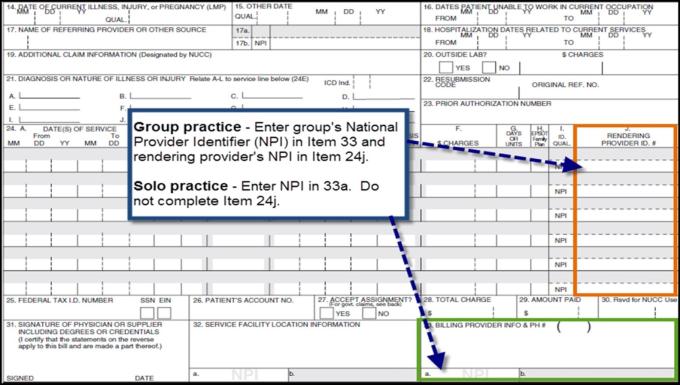
- Item 33 of the CMS-1500 claim form or electronic equivalent = individual physician National Provider Identifier (NPI) / group NPI
- Claim submitted by a group practice - Item 24J = physician’s NPI (billing for incident-to)
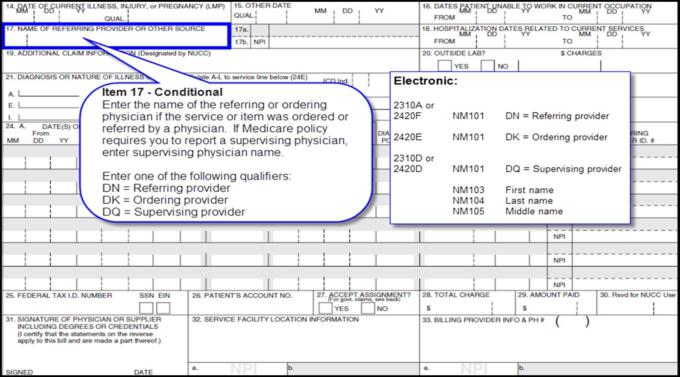
- Name of the physician or non-physician practitioner who performs the initial service and orders the non-physician service must appear in item 17
- Enter the qualifier to the left of the dotted vertical line on item 17 followed by the name
- DN = Referring Provider
- DK = Ordering Provider
- DQ = Supervising Provider
- Enter the qualifier to the left of the dotted vertical line on item 17 followed by the name
Example item 17:
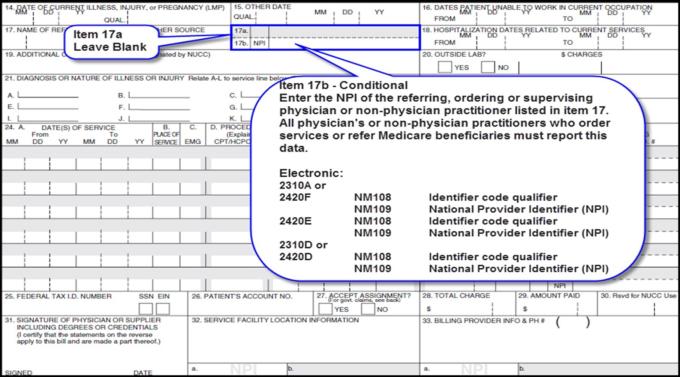
Claims for the services listed below require the name and NPI of the certifying physician or non-physician practitioner of the therapy plan of care be entered as the referring physician in Items 17 and 17b:
- Physical therapy
- Occupational therapy
- Speech-language pathology services
Example items 17a and 17b:
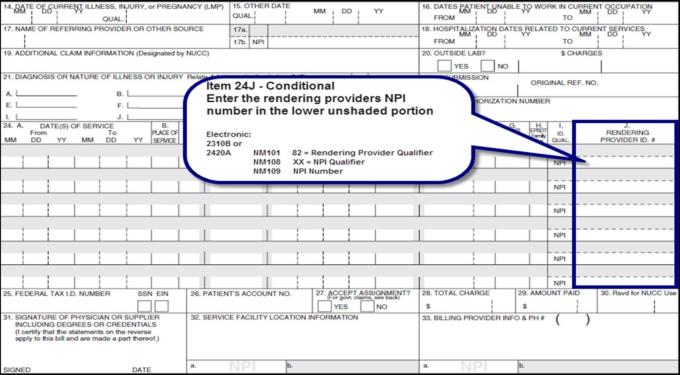
Enter the NPI of the supervisor (when the person who ordered the service is not supervising) in the lower un-shaded portion of item 24J.
Example item 24J:
When directly supervising the incident-to service, enter the signature of the ordering physician or non-physician practitioner in item 31.
Not supervising the incident-to service, enter the signature of the physician or non-physician practitioner providing the direct supervision in item 31.
Example items 24J and 31:
References