


Skilled nursing facility (SNF) benefits exhaust
A SNF is required to submit a bill even though no benefits may be payable by Medicare. Regardless of whether or not the services are covered by Medicare, CMS maintains a record of all inpatient services for each beneficiary. This enables CMS to keep track of a beneficiary’s benefit period.
A SNF must submit a benefits exhaust bill monthly for those patients that continue to receive skilled care and when there is a change in the level of care regardless of whether the benefits exhaust bill will be paid by Medicaid, a supplemental insurer, or private insurer.
Two types of benefits exhaust claims
- Full benefits exhaust claims:
- No benefit days remain in the beneficiary’s applicable benefit period for the submitted statement covers from/through date of the claim.
- Partial benefits exhaust claims:
- One or some benefit days remain in the beneficiary’s applicable benefit period for the submitted statement covers from/through date of the claim.
These bills are required in order to extend the beneficiary’s applicable benefit period posted in Common Working Files (CWF). When a change in level of care occurs after exhaustion of beneficiary’s covered days of care, the SNF must submit the benefits exhaust bill in the next billing cycle indicating that active care has ended for the beneficiary.
Note: Part B 22X bill types must be submitted after the benefits exhaust claim has been submitted and processed.
Providers may bill benefits exhaust claims using the default Health Insurance Prospective Payment System (HIPPS) code ZZZZZ in addition to an appropriate room & board revenue code only. No further ancillary services need to be billed on these claims. Once you bill the default, it cannot be changed.
SNF providers must submit benefits exhaust claims for those beneficiaries that continue to receive skilled services as follows.
Full or partial benefits exhaust claim
- Use appropriate covered type of bill (TOB):
- 211, 212, 213 or 214 for SNF.
- 181, 182, 183 or 184 for swing bed (SB).
- Note: TOBs 210 or 180 should not be used for benefits exhaust claims.
- Covered days and charges:
- Submit all covered days and charges as if the beneficiary had days available.
- Occurrence code (OC) A3 (benefits exhaust) and date will be applied by the Fiscal Intermediary Standard System (FISS) system when the claim processes and the days and charges after benefits exhaust will be moved to non-covered.
- Use appropriate patient status code.
- Value code (VC) 09 (First year coinsurance amount) 1.00 (If applicable, FISS will assign the correct coinsurance amount based off the CWF response).
- Occurrence span code (OSC) 70 with qualifying hospital stay dates.
- HIPPS code:
- Default HIPPS code ZZZZZ for full benefits exhaust.
- Add OC 50 and assessment reference date (ARD) date if not billing the default code
- Add remarks related to full or partial benefits exhaust.
- Submit any Part B services provided after skilled care ended, including therapy, on a TOB 22X after benefits exhaust claim processes.
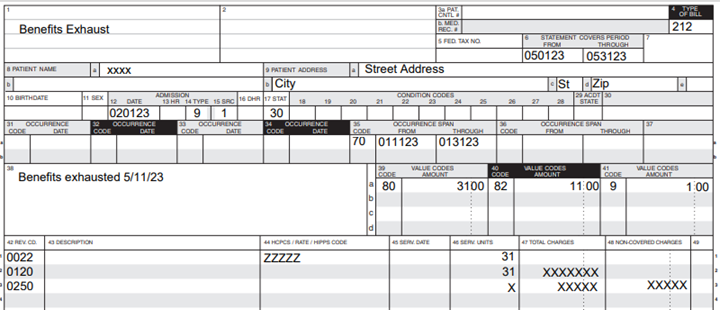
Benefits exhaust claim with a drop in level of care within the same month (patient remains in Medicare-certified area)
- Use appropriate TOB:
- TOB 212 or 213 for SNF.
- TOB 182 or 183 for SB.
- Note: Bill types 210 or 180 should not be used for benefits exhaust claims.
- OSC 70 with qualifying hospital stay dates.
- Covered days and charges:
- Submit all covered days and charges as if the beneficiary had days available until the date active care ended.
- OC A3 (benefits exhaust) and date will be applied by the FISS system when the claim processes and the days and charges after benefits exhaust will be moved to non-covered.
- Default HIPPS code ZZZZZ.
- VC 09 (First year coinsurance amount) 1.00 (If applicable, FISS will assign the correct coinsurance amount based off the CWF response).
- Patient status code 30 (still patient).
- Submit any Part B services provided after skilled care ended, including therapy, on a TOB 22X after benefits exhaust claim processes.
Benefits exhaust claim with a patient discharge
- Use appropriate TOB:
- TOB 211 or 214 for SNF.
- TOB 181 or 184 for SB.
- Note: Bill types 210 or 180 should not be used for benefits exhaust claims.
- OSC 70 with qualifying hospital stay dates.
- Covered days and charges:
- Submit all covered days and charges as if the beneficiary had days available until the date active care ended.
- VC 09 (First year coinsurance amount) 1.00 (If applicable, FISS will assign the correct coinsurance amount based off the CWF response).
- Use appropriate patient status code other than patient status code 30 (still patient).
- Submit any Part B services provided after skilled care ended, including therapy, on a TOB 22X after benefits exhaust claim processes.
Note: Billing all covered days and charges allow CWF to assign the correct benefits exhaust denial to the claim and appropriately post the claim to the patient’s benefit period.
Benefits exhaust bills must be submitted monthly.
References