


Billing outpatient observation services
Outpatient observation
Outpatient observation services are covered only when provided by order of a physician or another individual authorized by state licensure and hospital staff bylaws to admit patients to the hospital or to order outpatient tests.
Do not order observation services for a future elective surgery or outpatient surgery cases. Neither pre-operative nor post-operative services meet the definition of observation care.
Observation services must be patient specific and not part of the facility’s standard operating procedures. If observation is required after an outpatient surgical procedure and the patient meets criteria for observation monitoring after the standard surgical recovery period, you can place the patient in outpatient observation; however, the observation care will be bundled into payment for the surgical procedure.
Observation services are not considered medically necessary when the patient’s current medical condition does not warrant observation, or when there is not an expectation of significant deterioration in the patient’s medical condition in the near future.
Observation status
- Outpatient; released when the physician determines observation is no longer medically necessary.
- Physician’s order is required.
- Lack of documentation can lead to claim errors and payment retractions.
An order simply documented as “admit” will be treated as an inpatient admission. A clearly worded order such as “inpatient admission” or “place patient in outpatient observation” will ensure appropriate patient care and prevent hospital billing errors.
Note: It is imperative that there is a continued focus on lowering the Comprehensive Error Rate Testing (CERT) rate and facility involvement as a key component to this goal.
Outpatient observation notice
All patients receiving services in hospitals and clinical access hospitals (CAHs) must receive a Medicare outpatient observation notice (MOON) no later than 36 hours after observation services as an outpatient begin.
The MOON informs patients, who receive observation services for more than 24 hours, of the following:
- They are outpatients receiving observation services and not inpatients.
- Reasons for such status.
Hospitals and CAHs may deliver the MOON to a patient receiving observation services as an outpatient before the patient has received more than 24 hours of observation services but no later than 36 hours after observation services begin.
Refer to the CMS FFS & MA MOON webpage for the most current version of the MOON and detailed form instructions.
Observation hours
Observation is not expected to exceed 48 hours in duration. Greater than 48 hours in duration are seen as rare and exceptional cases.
Medicare will cover up to 72 hours if medically necessary.
Observation services rendered by non-OPPS providers beyond 72 hours is considered medically unlikely and should be submitted as non-covered on a second line of service. Bill claim as follows:
- First revenue code line billed as covered with 72 hours covered observation units and charges.
- Code G0378 should only be reported on the covered line.
- Second revenue code line billed with the hours exceeding medically necessary observation services with non-covered units and charges.
Follow the appeals process to have observation services exceeding 72 hours considered for payment.
Observation billing requirements
Observation services are outpatient services.
- Type of bill (TOB) 13X or 85X
- Revenue code 0762
- HCPCS code
- G0378: Hospital observation service, per hour. Report units of hours spent in observation (rounded to the nearest hour).
- G0379: Direct admission of patient for hospital observation care.
Report all services rendered while the patient is in observation with the appropriate revenue codes, HCPCS/CPT codes, and diagnosis codes. There are no specific diagnosis codes required.
Observation services should not be billed along with diagnostic or therapeutic services for which active monitoring is a part of the procedure. In situations where such a procedure interrupts observation services, hospitals may determine the most appropriate way to account for this time.
A hospital may record for each period of observation services, the beginning and ending times, during the hospital outpatient encounter and add the length of time for the periods of observation together to reach the total number of units reported on the claim for the hourly observation services, HCPCS code G0378 (hospital observation service, per hour). A hospital may also deduct the average length of time of the interrupting procedure, from the total duration of time that the patient receives observation services.
No payment will be made for observation when reported with a surgical procedure (SI T or SI J1) or the hours of observation reported is less than eight.
Condition Code 44 would be reported if the patient was initially admitted as inpatient and then prior to discharge, status was changed to observation.
- Decision must be made while the beneficiary is still a patient, prior to discharge.
- Decision cannot be made post discharge.
Direct admit example
A patient was sent from their provider's office for a direct admit to observation care. The patient arrived at the facility and started treatment at 11 a.m. on 02/17/2025 and was discharged at 4 a.m. the next day.
- 02/17, at 11 a.m. through 02/18, at 4 a.m. = 17 total hours.
Observation reporting:
- Report one line item with revenue code 0762, HCPCS code G0378, line-item date of service 02/17, and 17 units.
- Report one line item with revenue code 0762, HCPCS code G0379, line-item date of service 02/17, and 1 unit.
Carve out example:
A patient is placed into observation on 01/06, at 2 p.m. and is discharged from the facility on 01/07, at 6 p.m. The patient had a surgical procedure performed that lasted three hours.
- 01/06, at 2:00 pm through 01/07, at 6 p.m. = 28 total hours.
- Carve out three hours for surgery = 25 total hours.
Observation reporting:
- Report one line item with revenue code 0762, HCPCS code G0378, line-item date of service 01/06, and 25 units.
Observation spanning more than one calendar day
Observation may span multiple calendar dates.
When outpatient observation services span more than one calendar day:
- The total accumulation of observation time for the entire period of observation must be included on a single line.
- The date of service would be the date observation care began.
- Note: For non-OPPS providers, if the total hours of observation exceed 72, a second line of observation should be billed and the additional hours, which are considered medically unlikely, should be billed as non-covered.
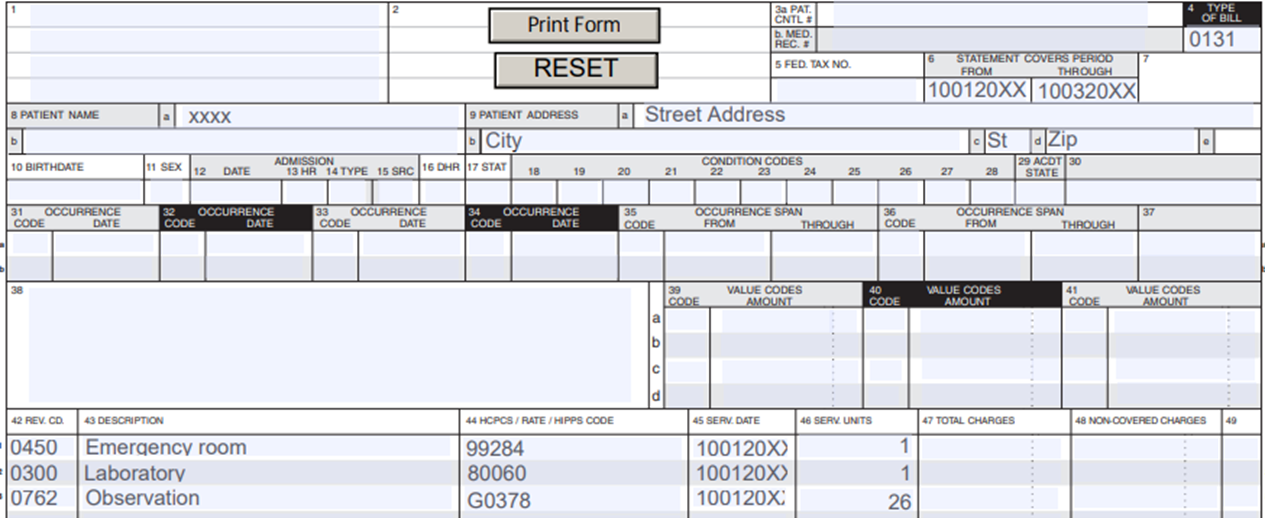
In the observation claim example below, notice that observation care spans two calendar days.
- The statement from and through dates will reflect the entire outpatient episode of care, in this instance 10/01, through 10/02.
- The patient is placed in observation from 4 p.m. on 10/01, and remains until discharge at 6 p.m. on 10/02, for a total of 26 hours of observation time.
- Report one line item with revenue code 0762, HCPCS code G0378, line-item date of service 10/01, and 26 units.
- The total accumulation of observation time is included on one line with the date observation care began.
Observation spanning over calendar year end
Observation care may span over the calendar year end when the beneficiary goes to the emergency room (ER) 12/31/XX and then discharged from care 01/01/XX, or later.
The observation code G0378 and the appropriate evaluation and management (E&M) code must be reported on the same claim for the provider to receive the Comprehensive Ambulatory Payment Classification (APC) payment.
If the patient is admitted into observation care on the 01/01/XX claim, then the provider will receive the visit APC payment on the 12/31/XX claim.
- It is permissible for the provider to report the observation code on the 12/31/XX claim.
Billing examples:
Observation and ER visit billed on 12/31XX claim.
- The patient was seen in the ER on 12/31/20XX, was placed in observation on 12/31/20XX, and discharged home on 1/1/20XX.
- First claim:
- TOB = 132 (first in a series of claim).
- From date and through date = 12/31/2023 through 12/31/2023.
- Patient status = 30 (still patient).
- Report both the appropriate E&M code for the visit and the observation code, with all observation hours, on this claim.
- Second claim:
- TOB = 134 (discharge bill).
- From date and through date = 1/1/20XX through 1/1/20XX.
- Patient status = 01 (discharged home).
- Report all the ancillary charges that occurred on 01/01/24 on this claim.
Observation and ER visit billed on separate claims:
- The patient was seen in the ER on 12/31/XX, was placed in observation on 01/01/XX, and discharged home on 01/01/XX. The provider is not reporting observation on the 12/31/XX claim.
- First claim:
- TOB = 132 (first in a series of claim).
- From date and through date= 12/31/20XX through 12/31/20XX.
- Patient status = 30 (still patient).
- Report the appropriate E&M code for the visit.
- Claim will receive the assigned APC for the E&M code reported.
- Second claim:
- TOB = 134 (discharge bill).
- From date and through date = 1/1/20XX through 1/1/20XX.
- Report the observation code, with all observation hours, and all ancillary charges that occurred on 01/01/20XX on this claim.
- Patient status = 01 (discharged home).
- Claim will return for reason code W7057 and claims can override.
Reminders
- Observation services are provided on an outpatient basis.
- Should be billed according to observation billing guidelines.
- All hours of observation up to 72 hours should be submitted on a single line.
- The date of service being the date the order for observation was written.
- Orders for observation services are not considered to be valid inpatient admission levels of care orders.
- When billing observation services, we expect the charges associated with those services to be billed as outpatient level of care services.
Observation to inpatient status
Observation ends when all clinical or medical interventions have been completed, including follow-up care furnished by hospital staff and physicians that may take place after a physician has ordered the patient be discharged home or admitted as an inpatient.
If the patient is admitted as an inpatient after observation, an order to admit is required.
Additionally, if the patient is discharged from observation and subsequently admitted as an inpatient, all services provided to the patient while in observation are included on the inpatient claim.
Since observation is considered an outpatient hospital service performed within three days of an inpatient admission, the services follow the three-day/one-day payment window.
References
- CMS IOM Publication 100-04, Chapter 1, Section 50.3.2
- CMS IOM Publication 100-04, Claims Processing Manual, Chapter 3, Section 40.3
- CMS IOM Publication 100-04, Claims Processing Manual, Chapter 4, Section 290
-
MLN Matters, MM9935 - Medicare Outpatient Observation Notice (MOON) Instructions